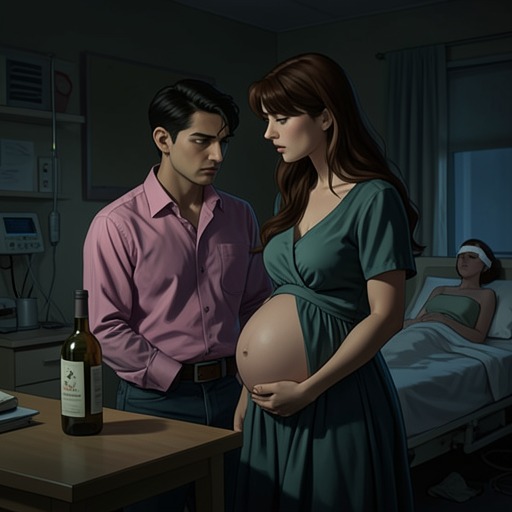
Yohan Accepts Responsibility
The Beki CEO Got Me PregnantYohan Accepts Responsibility is the turning point in which Yohan Xyle Laroses responds to Kazumi Lhynx Valeres’s pregnancy by choosing obligation over escape. The decision begins in uncertainty and resistance, but develops into housing, protection, medical care, public defense, marriage, and parenthood. It therefore changes the pregnancy from a private crisis into the organizing responsibility of Yohan’s later life, while preserving the unresolved emotional contradiction between his long-standing gay identity, his feminine self-presentation, his attachment to Vixon Rae, and his growing bond with Kazumi.
The Pregnancy and Yohan’s First Reaction
Kazumi and Yohan are not strangers brought together by the pregnancy. They met in sixth grade, remained best friends through college, separated after graduation, and later reunited when Kazumi became an assistant in Yohan’s highly successful company. Kazumi’s account presents Yohan as her only boss and identifies him as gay, while also emphasizing that other people’s judgment of his sexuality is not theirs to control. This history gives the pregnancy an unusually intimate foundation: the person asking Yohan to respond is his oldest friend and employee, not a casual acquaintance.
The revelation is delivered with a pregnancy test. When Kazumi says that she is pregnant and shows him the test, Yohan becomes stunned and pale, while Kazumi waits anxiously for his reaction. His immediate internal response is not romantic certainty but disbelief and practical alarm. He recognizes that the pregnancy is real and asks himself whether he must take responsibility for Kazumi, even framing the situation through the loss of his sperm cells. The thought is deliberately comic, but it also shows how far he initially is from an uncomplicated vision of fatherhood.
Yohan’s hesitation is intensified by Vixon Rae. He worries that Vixon, who strongly dislikes Kazumi, will become angry if he accepts responsibility for her and the child. At the same time, Yohan acknowledges that he and Vixon have recently grown close in a way that resembles a romantic relationship. The pregnancy thus arrives at the precise moment when another attachment seems to be deepening, making responsibility feel like a threat to an existing emotional arrangement rather than a simple moral duty.
The Declaration and Its Immediate Terms
Yohan ultimately makes his choice through an explicit act of speech. After calming himself in the comfort room, he decides that he cannot run away from a child he has helped create. His reasoning is direct: because he feels compassion for the baby, he will take responsibility for Kazumi. He also recognizes that they are twenty-nine and no longer children, making evasion harder to justify. His decision is ethically significant but emotionally qualified, because he still states that he does not like the child’s mother.
When he returns to the office, Kazumi is still waiting. Yohan crosses his arms, adopts an affected manner, and tells her, "Pananagutan kita." He then adds, "Tsaka sa bahay ko nalang ikaw tumira for now." These declarations perform two actions at once. The first accepts financial and parental responsibility; the second immediately converts that acceptance into a living arrangement by inviting Kazumi into his house. Kazumi smiles, indicating the emotional force of the promise even though Yohan presents it with theatrical irritation rather than tenderness.
The arrangement is not entirely voluntary from Yohan’s perspective. When he later resists a request, Kazumi threatens to tell Vixon that Yohan made her pregnant. Yohan tries to stop her from taking out her phone and gives in. The exchange reveals the unstable, bargaining quality of their early cohabitation: Yohan has accepted responsibility, but Kazumi still has to pressure him to honor particular obligations. His commitment is real, yet it is repeatedly tested through humor, embarrassment, and the fear of exposure.
Responsibility as Protection
Yohan’s responsibility becomes more substantial when Kazumi is harmed during pregnancy. He explains that he was in a meeting when an uneasy feeling drove him to leave and return to the office, where he found Kazumi bleeding. He believes Vixon attacked her. At the hospital, the doctor instructs Yohan to dismiss Vixon, restrict Kazumi’s movement, and ensure that she rests while taking wound medication and vitamins for the baby. Yohan accepts the practical demands of this care rather than treating the pregnancy as Kazumi’s private burden.
The protective role also extends beyond medical instructions. When Xan insults Kazumi and presents himself as falsely kind toward her, Yohan confronts him. He accuses Xan of displaying arrogance, pretending to be gentle, and potentially answering Kazumi’s affection only to replace, deceive, use, and discard her. Yohan orders him to leave the company. This defense is important because it shows responsibility becoming active protection: Yohan does not merely provide a home but uses his authority as employer to intervene when Kazumi is threatened or demeaned.
The response to Vixon’s violence has institutional consequences. Yohan’s workers call the police, and Vixon is imprisoned for two years. Yohan feels somewhat reassured once Vixon is detained, although he and Kazumi still have to remain careful. The aftermath also exposes the labor dimension of Yohan’s new role. Without Vixon, he must manage office arrangements and organization alone, but he accepts that burden and continues. His authority over employees, including the power to fire Vixon, is folded into the domestic and medical responsibility created by the pregnancy.
From Parental Duty to Marriage
Yohan’s acceptance eventually reaches the level of legal and social family structure, but the reason he gives Kazumi is not initially romantic. When Kazumi asks why he suddenly proposed, Yohan explains that he does not want their child to grow up hurt or confused by seeing each parent with an unknown loved one. He also says that he will marry Kazumi so that he can properly uphold his responsibility as a mother, jokingly insisting on the gendered title despite his status as the child’s biological father.
Kazumi laughs at the joke but remains disappointed because she had expected the proposal to mean that Yohan loved her. The scene preserves the difference between duty and desire. Yohan offers marriage as protection against the child’s future confusion and as a public form of accountability, while Kazumi hears the proposal through the lens of her unrequited love. The same act therefore carries two meanings: for Yohan, it is an extension of parental responsibility; for Kazumi, it risks becoming evidence of a love that has not yet been confessed.
The wedding formalizes their new arrangement. When the officiant asks whether Kazumi takes Yohan as her lawful husband, Kazumi corrects the gendered assumption by saying that she is the wife and not the husband. She nevertheless vows to take Yohan as her husband and promises fidelity, love, and honor in good times and bad, sickness and health. Their marriage adopts the language of conventional heterosexual vows while the characters continually revise its roles, titles, and meanings.
Parenthood, Identity, and Long-Term Meaning
The birth gives Yohan’s decision its most concrete confirmation. A nurse returns carrying the baby and addresses both Kazumi and Yohan as the Laroses parents. Yohan takes the baby into his arms and remains overwhelmed that the child has been born. The newborn is to be breastfed, receive vitamin K and eye drops, undergo measurements, footprints, screening tests, pediatric examination, and a first bath. These details place Yohan’s declaration within the ordinary procedures of parental care: responsibility is no longer an abstract promise but a continuing series of bodily, medical, and administrative acts.
Ten years later, Yohan and Kazumi are still together, married, and raising their child. Their later history is not presented as a simple erasure of the contradictions that began with the pregnancy. Yohan remains committed to feminine presentation, including dresses, makeup, and beautification. A planned sex-change operation and breast implants never take place, and he chooses to retain his penis because he fears its removal might bring bad luck. Their child sees nothing wrong with this expression and understands it as Yohan being true to himself.
This ending gives Yohan Accepts Responsibility a broader significance than a conventional conversion into husbandhood or fatherhood. Yohan’s responsibility does not require him to abandon his gay identity, feminine appearance, or bodily choices. The story instead places parental obligation, marriage, gender expression, and sexuality in the same family structure without making one automatically cancel the others. His first decision is made reluctantly and partly for the child, but its long-term consequence is a durable household in which responsibility becomes the ground from which intimacy can develop rather than a demand that identity be surrendered.